Web Design
"From Mom to Mom": Translating a Vision into a Scalable Brand Ecosystem
Launching a health brand is a balancing act. Lean too far into "clinical," and you feel like a hospital; lean too far into "friendly," and you lose authority. I partnered with a certified nutritionist to launch Nutrict, building a vivid "Mom-to-Mom" visual identity, a conversion-focused website, and the foundation for a "Yuka-style" food scoring app.
Industry :
Wellness
Client :
Nutrict
Project Duration :
10 Weeks
Year :
2024
TLDR
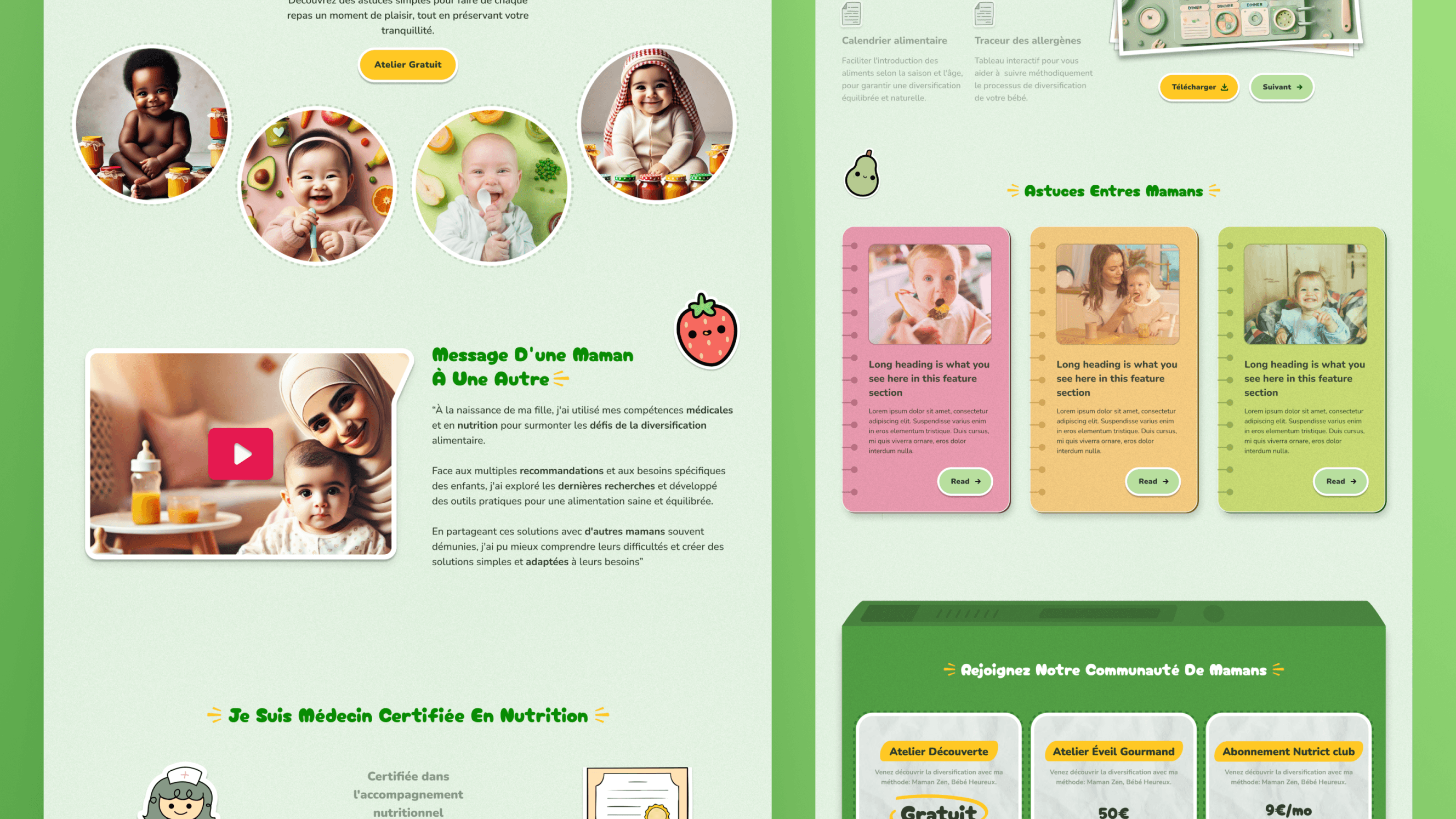
Nutrict needed to break the mold of "sterile" nutrition brands to connect with anxious moms. I acted as the Art Director, Designer, and Manager. I created a vivid visual identity using "Real World" metaphors (Recipe Books, Photo Albums) and designed the marketing site in just 4 weeks. Later, I managed the app design process, acting as a Shield and Efficiency Amplifier, validating all work before the client ever saw it. The result was a cohesive ecosystem that converted 4 high-ticket clients in its first month.
The Challenge: The "Green" Trap
After browsing a dozen other brands, I identified two specific tensions in the project:
Differentiation: The market was saturated with "Pharmacy Green" medical sites and beige "Instagram Aesthetic" blogs. But the sameness went deeper than color—competitors relied on rigid grids, boxy cards, and standard templates. To be visible, we had to break the rectangle.
Trust vs. Warmth: The brand needed to be credible enough for doctors to recommend, but warm enough for moms to feel safe, not judged.
The Approach: "From Mom to Mom"
I defined the core strategic pillar as "From Mom to Mom." This wasn't about a doctor lecturing a patient; it was about a peer sharing advice. This guided every visual decision.
1. Visual Identity
Breaking the Pharmacy Rules I rejected the standard clinical palette.
The Palette: I used a vivid, multi-color palette to bring soul to the brand, moving away from "safe" green to energetic tones that felt like a messy, happy kitchen.

The Typography: I paired a clean sans-serif (for data readability) with a "Bubbly" header font that felt approachable and soft.

The Soul: Custom illustrations were key. Instead of stock photos of perfect salads, I created playful illustrations that acted like "Fridge Stickers"—adding personality to static forms and empty states.

2. Web Experience: Lean Process, Tactile UI
With a 4-week deadline, we couldn't afford a long discovery phase. I needed a workflow that moved from "Idea" to "Structure" in hours, not days.
A) The Lean Setup (Research & Wireframing)
I started with a targeted competitor audit and a Google Doc questionnaire to lock down the requirements. We defined a streamlined sitemap—Home, Blog, Recipes, and Services—deciding to merge the "Tools" section to avoid empty pages.
The Accelerator: To move fast, I used Relume to generate the full wireframe structure. Since Relume provides desktop and mobile components out of the box, I skipped the manual box-drawing.
The Sync: I shared the Figma file 24 hours later for async comments. This allowed us to spend our live meeting validating the flow, not debating header sizes.

B) UI as a Metaphor
To make the digital experience feel personal, I anchored the interface in real-world objects that moms use daily. I wanted the site to feel like a kitchen counter, not a database.
The Intro as a "Speech Bubble": I rejected the standard sterile biography. Her welcome video sits inside a speech bubble container, visually signaling that this is a dialogue between peers, not a lecture from a doctor.

Testimonials as "Sticky Notes": Social proof was styled like handwritten notes you’d leave on the counter, reinforcing the peer-to-peer vibe.

The Blog as a "Cookbook": I avoided the standard white card. Instead, tips and recipe posts were styled to look like a cuisine book, complete with textured edges.

Tools as a “Photo Album”: I visualized the tools as a free album of downloadable files, something users flip through like family photos and take home.

Pricing on a “Paper Binder”: Service packages sit on top of a paper binder: open, browse, learn.

The Newsletter as a "Pinned Note": To avoid the aggressive "Subscribe Now" feel, I styled the signup form like a note taped to the wall with tape. It frames the email list as a helpful reminder between friends, not a corporate data grab.

Design Management: The "Shield & Amplifier"
After executing the website, I managed an external designer for the mobile app. My role wasn't just to forward emails; I had to control the quality gate.
The Shield
I protected the app designer from vague or shifting client feedback. The client never saw the work until I had personally validated it. This meant the designer only received clear, actionable feedback, not stream-of-consciousness thoughts.

The Efficiency Amplifier
It wasn’t about speed at any cost; it was about supporting the designer with clear direction upfront, so delivery stayed smooth and rework stayed low.
To make this work, I established a rigorous "Pre-Flight" process for the designer:
The 1:1 Live Context Tour: I didn't just send a PDF. I got on a call and walked the designer through the soul of the project context, the brand, and the app features.

The 1:1 Micro, Bite-Size Tips: I shared quick, practical nudges in the moment. A mix of design fundamentals (hierarchy, contrast, spacing, readability) and Figma mechanics (responsiveness, constraints, components, scalable layout patterns).

The Cheat Sheet: I provided a checklist for them to run before every handoff. It wasn't about pixel-peeping; it was about product integrity

Results & Impact
By acting as both the creator and the director, we achieved a level of consistency that usually takes large teams months to build.
The seamless transition from the "Cookbook" website to the "Yuka-style" app made the brand feel established and premium from Day 1.
4 weeks
Brand & Website designed
6 weeks
App MVP design completed
99% Speed
App MVP design completed
4 clients
Secured first month post-launch
What I Learned
You are the Quality Gate. As a lead, if you pass bad design to a client, you failed, not the junior designer. Being a "Shield" builds trust with your team and confidence with your client.
Metaphors create memory. Users forget "lists," but they remember "Cookbooks" and "Albums." Anchoring UI in the physical world made the brand sticky.
Context beats Correction. Spending one hour on a live call to explain the vision saved ten hours of correcting mistakes later.
Closing
This project was a reminder that design leadership isn't just about pixel perfection; it's about creating a safe environment where the client feels heard and the designer feels guided. By defining a clear visual language and enforcing a strict validation process, we built a brand that spoke "From Mom to Mom" fluently across every touchpoint.
More Projects


Web Design
"From Mom to Mom": Translating a Vision into a Scalable Brand Ecosystem
Launching a health brand is a balancing act. Lean too far into "clinical," and you feel like a hospital; lean too far into "friendly," and you lose authority. I partnered with a certified nutritionist to launch Nutrict, building a vivid "Mom-to-Mom" visual identity, a conversion-focused website, and the foundation for a "Yuka-style" food scoring app.
Industry :
Wellness
Client :
Nutrict
Project Duration :
10 Weeks
Year :
2024
TLDR
Nutrict needed to break the mold of "sterile" nutrition brands to connect with anxious moms. I acted as the Art Director, Designer, and Manager. I created a vivid visual identity using "Real World" metaphors (Recipe Books, Photo Albums) and designed the marketing site in just 4 weeks. Later, I managed the app design process, acting as a Shield and Efficiency Amplifier, validating all work before the client ever saw it. The result was a cohesive ecosystem that converted 4 high-ticket clients in its first month.
The Challenge: The "Green" Trap
After browsing a dozen other brands, I identified two specific tensions in the project:
Differentiation: The market was saturated with "Pharmacy Green" medical sites and beige "Instagram Aesthetic" blogs. But the sameness went deeper than color—competitors relied on rigid grids, boxy cards, and standard templates. To be visible, we had to break the rectangle.
Trust vs. Warmth: The brand needed to be credible enough for doctors to recommend, but warm enough for moms to feel safe, not judged.
The Approach: "From Mom to Mom"
I defined the core strategic pillar as "From Mom to Mom." This wasn't about a doctor lecturing a patient; it was about a peer sharing advice. This guided every visual decision.
1. Visual Identity
Breaking the Pharmacy Rules I rejected the standard clinical palette.
The Palette: I used a vivid, multi-color palette to bring soul to the brand, moving away from "safe" green to energetic tones that felt like a messy, happy kitchen.
The Typography: I paired a clean sans-serif (for data readability) with a "Bubbly" header font that felt approachable and soft.
The Soul: Custom illustrations were key. Instead of stock photos of perfect salads, I created playful illustrations that acted like "Fridge Stickers"—adding personality to static forms and empty states.
2. Web Experience: Lean Process, Tactile UI
With a 4-week deadline, we couldn't afford a long discovery phase. I needed a workflow that moved from "Idea" to "Structure" in hours, not days.
A) The Lean Setup (Research & Wireframing)
I started with a targeted competitor audit and a Google Doc questionnaire to lock down the requirements. We defined a streamlined sitemap—Home, Blog, Recipes, and Services—deciding to merge the "Tools" section to avoid empty pages.
The Accelerator: To move fast, I used Relume to generate the full wireframe structure. Since Relume provides desktop and mobile components out of the box, I skipped the manual box-drawing.
The Sync: I shared the Figma file 24 hours later for async comments. This allowed us to spend our live meeting validating the flow, not debating header sizes.
B) UI as a Metaphor
To make the digital experience feel personal, I anchored the interface in real-world objects that moms use daily. I wanted the site to feel like a kitchen counter, not a database.
The Intro as a "Speech Bubble": I rejected the standard sterile biography. Her welcome video sits inside a speech bubble container, visually signaling that this is a dialogue between peers, not a lecture from a doctor.
Testimonials as "Sticky Notes": Social proof was styled like handwritten notes you’d leave on the counter, reinforcing the peer-to-peer vibe.
The Blog as a "Cookbook": I avoided the standard white card. Instead, tips and recipe posts were styled to look like a cuisine book, complete with textured edges.
Tools as a “Photo Album”: I visualized the tools as a free album of downloadable files, something users flip through like family photos and take home.
Pricing on a “Paper Binder”: Service packages sit on top of a paper binder: open, browse, learn.
The Newsletter as a "Pinned Note": To avoid the aggressive "Subscribe Now" feel, I styled the signup form like a note taped to the wall with tape. It frames the email list as a helpful reminder between friends, not a corporate data grab.
Design Management: The "Shield & Amplifier"
After executing the website, I managed an external designer for the mobile app. My role wasn't just to forward emails; I had to control the quality gate.
The Shield
I protected the app designer from vague or shifting client feedback. The client never saw the work until I had personally validated it. This meant the designer only received clear, actionable feedback, not stream-of-consciousness thoughts.
The Efficiency Amplifier
It wasn’t about speed at any cost; it was about supporting the designer with clear direction upfront, so delivery stayed smooth and rework stayed low.
To make this work, I established a rigorous "Pre-Flight" process for the designer:
The 1:1 Live Context Tour: I didn't just send a PDF. I got on a call and walked the designer through the soul of the project context, the brand, and the app features.
The 1:1 Micro, Bite-Size Tips: I shared quick, practical nudges in the moment. A mix of design fundamentals (hierarchy, contrast, spacing, readability) and Figma mechanics (responsiveness, constraints, components, scalable layout patterns).
The Cheat Sheet: I provided a checklist for them to run before every handoff. It wasn't about pixel-peeping; it was about product integrity
Results & Impact
By acting as both the creator and the director, we achieved a level of consistency that usually takes large teams months to build.
The seamless transition from the "Cookbook" website to the "Yuka-style" app made the brand feel established and premium from Day 1.
4 weeks
Brand & Website designed
6 weeks
App MVP design completed
99% Speed
App MVP design completed
4 clients
Secured first month post-launch
What I Learned
You are the Quality Gate. As a lead, if you pass bad design to a client, you failed, not the junior designer. Being a "Shield" builds trust with your team and confidence with your client.
Metaphors create memory. Users forget "lists," but they remember "Cookbooks" and "Albums." Anchoring UI in the physical world made the brand sticky.
Context beats Correction. Spending one hour on a live call to explain the vision saved ten hours of correcting mistakes later.
Closing
This project was a reminder that design leadership isn't just about pixel perfection; it's about creating a safe environment where the client feels heard and the designer feels guided. By defining a clear visual language and enforcing a strict validation process, we built a brand that spoke "From Mom to Mom" fluently across every touchpoint.
More Projects
Web Design
"From Mom to Mom": Translating a Vision into a Scalable Brand Ecosystem
Launching a health brand is a balancing act. Lean too far into "clinical," and you feel like a hospital; lean too far into "friendly," and you lose authority. I partnered with a certified nutritionist to launch Nutrict, building a vivid "Mom-to-Mom" visual identity, a conversion-focused website, and the foundation for a "Yuka-style" food scoring app.
Industry :
Wellness
Client :
Nutrict
Project Duration :
10 Weeks
Year :
2024
TLDR
Nutrict needed to break the mold of "sterile" nutrition brands to connect with anxious moms. I acted as the Art Director, Designer, and Manager. I created a vivid visual identity using "Real World" metaphors (Recipe Books, Photo Albums) and designed the marketing site in just 4 weeks. Later, I managed the app design process, acting as a Shield and Efficiency Amplifier, validating all work before the client ever saw it. The result was a cohesive ecosystem that converted 4 high-ticket clients in its first month.
The Challenge: The "Green" Trap
After browsing a dozen other brands, I identified two specific tensions in the project:
Differentiation: The market was saturated with "Pharmacy Green" medical sites and beige "Instagram Aesthetic" blogs. But the sameness went deeper than color—competitors relied on rigid grids, boxy cards, and standard templates. To be visible, we had to break the rectangle.
Trust vs. Warmth: The brand needed to be credible enough for doctors to recommend, but warm enough for moms to feel safe, not judged.
The Approach: "From Mom to Mom"
I defined the core strategic pillar as "From Mom to Mom." This wasn't about a doctor lecturing a patient; it was about a peer sharing advice. This guided every visual decision.
1. Visual Identity
Breaking the Pharmacy Rules I rejected the standard clinical palette.
The Palette: I used a vivid, multi-color palette to bring soul to the brand, moving away from "safe" green to energetic tones that felt like a messy, happy kitchen.
The Typography: I paired a clean sans-serif (for data readability) with a "Bubbly" header font that felt approachable and soft.
The Soul: Custom illustrations were key. Instead of stock photos of perfect salads, I created playful illustrations that acted like "Fridge Stickers"—adding personality to static forms and empty states.
2. Web Experience: Lean Process, Tactile UI
With a 4-week deadline, we couldn't afford a long discovery phase. I needed a workflow that moved from "Idea" to "Structure" in hours, not days.
A) The Lean Setup (Research & Wireframing)
I started with a targeted competitor audit and a Google Doc questionnaire to lock down the requirements. We defined a streamlined sitemap—Home, Blog, Recipes, and Services—deciding to merge the "Tools" section to avoid empty pages.
The Accelerator: To move fast, I used Relume to generate the full wireframe structure. Since Relume provides desktop and mobile components out of the box, I skipped the manual box-drawing.
The Sync: I shared the Figma file 24 hours later for async comments. This allowed us to spend our live meeting validating the flow, not debating header sizes.
B) UI as a Metaphor
To make the digital experience feel personal, I anchored the interface in real-world objects that moms use daily. I wanted the site to feel like a kitchen counter, not a database.
The Intro as a "Speech Bubble": I rejected the standard sterile biography. Her welcome video sits inside a speech bubble container, visually signaling that this is a dialogue between peers, not a lecture from a doctor.
Testimonials as "Sticky Notes": Social proof was styled like handwritten notes you’d leave on the counter, reinforcing the peer-to-peer vibe.
The Blog as a "Cookbook": I avoided the standard white card. Instead, tips and recipe posts were styled to look like a cuisine book, complete with textured edges.
Tools as a “Photo Album”: I visualized the tools as a free album of downloadable files, something users flip through like family photos and take home.
Pricing on a “Paper Binder”: Service packages sit on top of a paper binder: open, browse, learn.
The Newsletter as a "Pinned Note": To avoid the aggressive "Subscribe Now" feel, I styled the signup form like a note taped to the wall with tape. It frames the email list as a helpful reminder between friends, not a corporate data grab.
Design Management: The "Shield & Amplifier"
After executing the website, I managed an external designer for the mobile app. My role wasn't just to forward emails; I had to control the quality gate.
The Shield
I protected the app designer from vague or shifting client feedback. The client never saw the work until I had personally validated it. This meant the designer only received clear, actionable feedback, not stream-of-consciousness thoughts.
The Efficiency Amplifier
It wasn’t about speed at any cost; it was about supporting the designer with clear direction upfront, so delivery stayed smooth and rework stayed low.
To make this work, I established a rigorous "Pre-Flight" process for the designer:
The 1:1 Live Context Tour: I didn't just send a PDF. I got on a call and walked the designer through the soul of the project context, the brand, and the app features.
The 1:1 Micro, Bite-Size Tips: I shared quick, practical nudges in the moment. A mix of design fundamentals (hierarchy, contrast, spacing, readability) and Figma mechanics (responsiveness, constraints, components, scalable layout patterns).
The Cheat Sheet: I provided a checklist for them to run before every handoff. It wasn't about pixel-peeping; it was about product integrity
Results & Impact
By acting as both the creator and the director, we achieved a level of consistency that usually takes large teams months to build.
The seamless transition from the "Cookbook" website to the "Yuka-style" app made the brand feel established and premium from Day 1.
4 weeks
Brand & Website designed
6 weeks
App MVP design completed
99% Speed
App MVP design completed
4 clients
Secured first month post-launch
What I Learned
You are the Quality Gate. As a lead, if you pass bad design to a client, you failed, not the junior designer. Being a "Shield" builds trust with your team and confidence with your client.
Metaphors create memory. Users forget "lists," but they remember "Cookbooks" and "Albums." Anchoring UI in the physical world made the brand sticky.
Context beats Correction. Spending one hour on a live call to explain the vision saved ten hours of correcting mistakes later.
Closing
This project was a reminder that design leadership isn't just about pixel perfection; it's about creating a safe environment where the client feels heard and the designer feels guided. By defining a clear visual language and enforcing a strict validation process, we built a brand that spoke "From Mom to Mom" fluently across every touchpoint.